Time Series

Alex Reinhart

Statistics & Data Science 36-468/668

David Brown

Dept. of English

Fall 2025

Frequency of witch hunt by decade
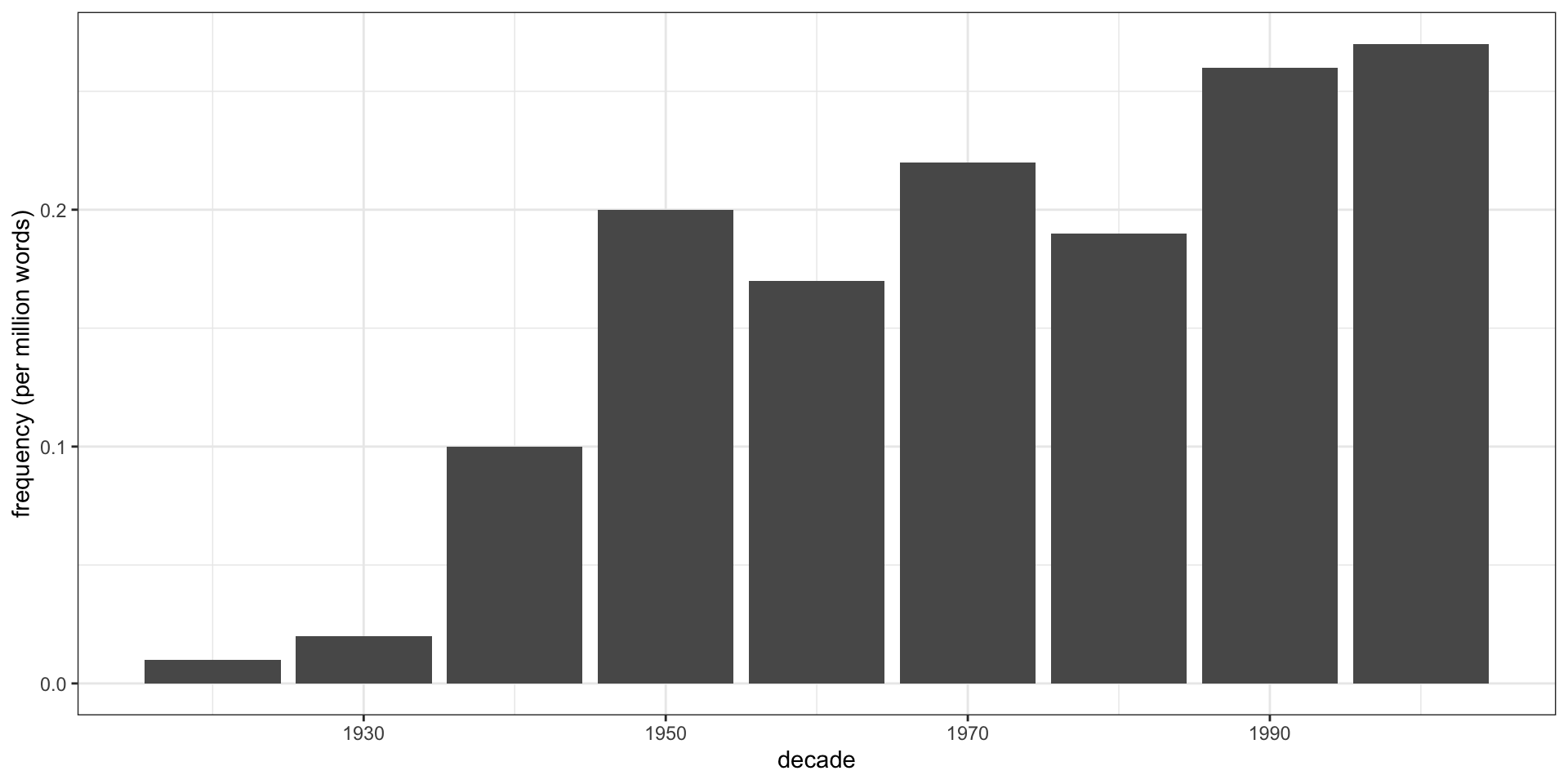
Frequency of witch hunt by decade, with CIs
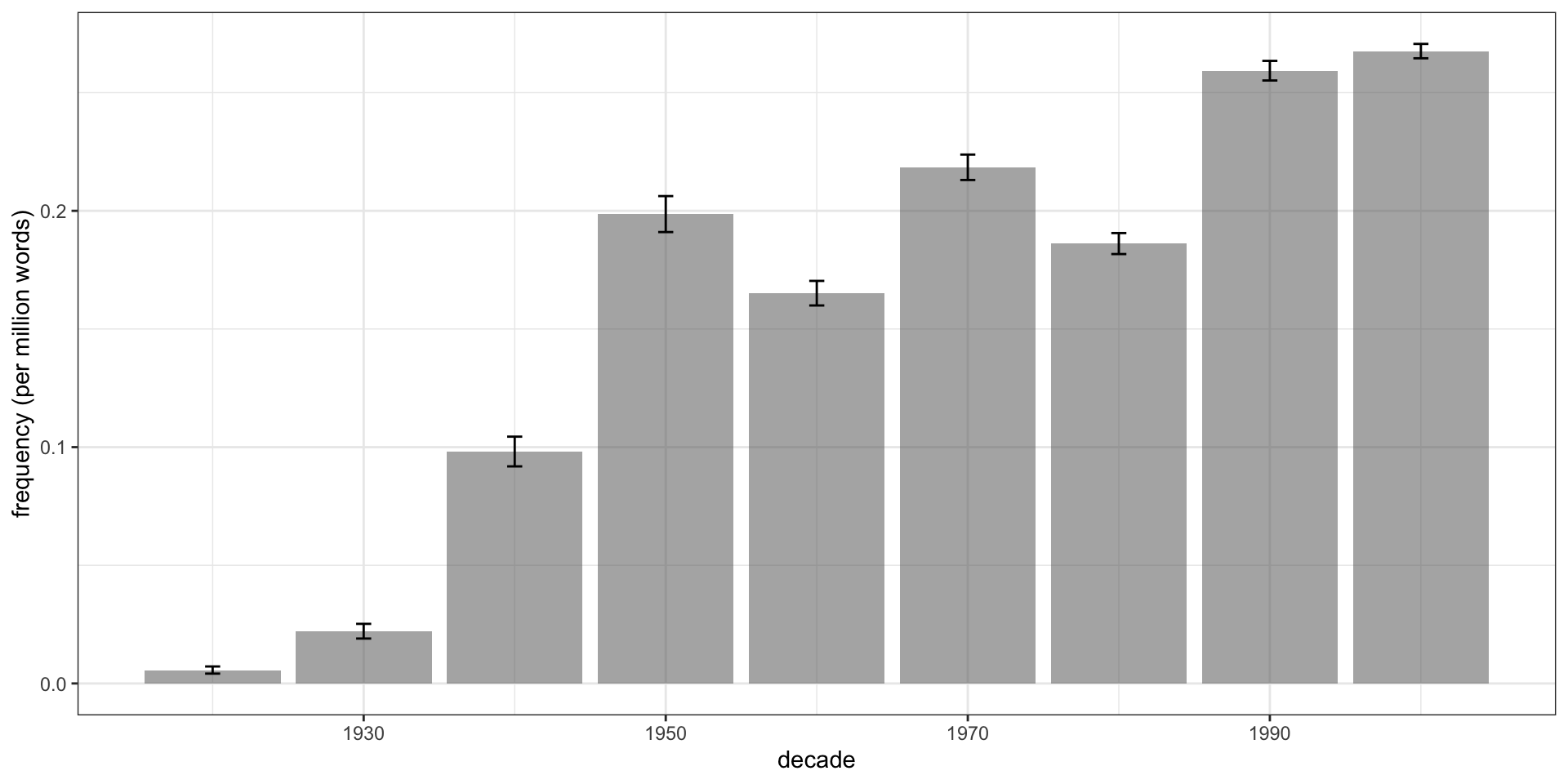
Frequency of witch hunt by decade
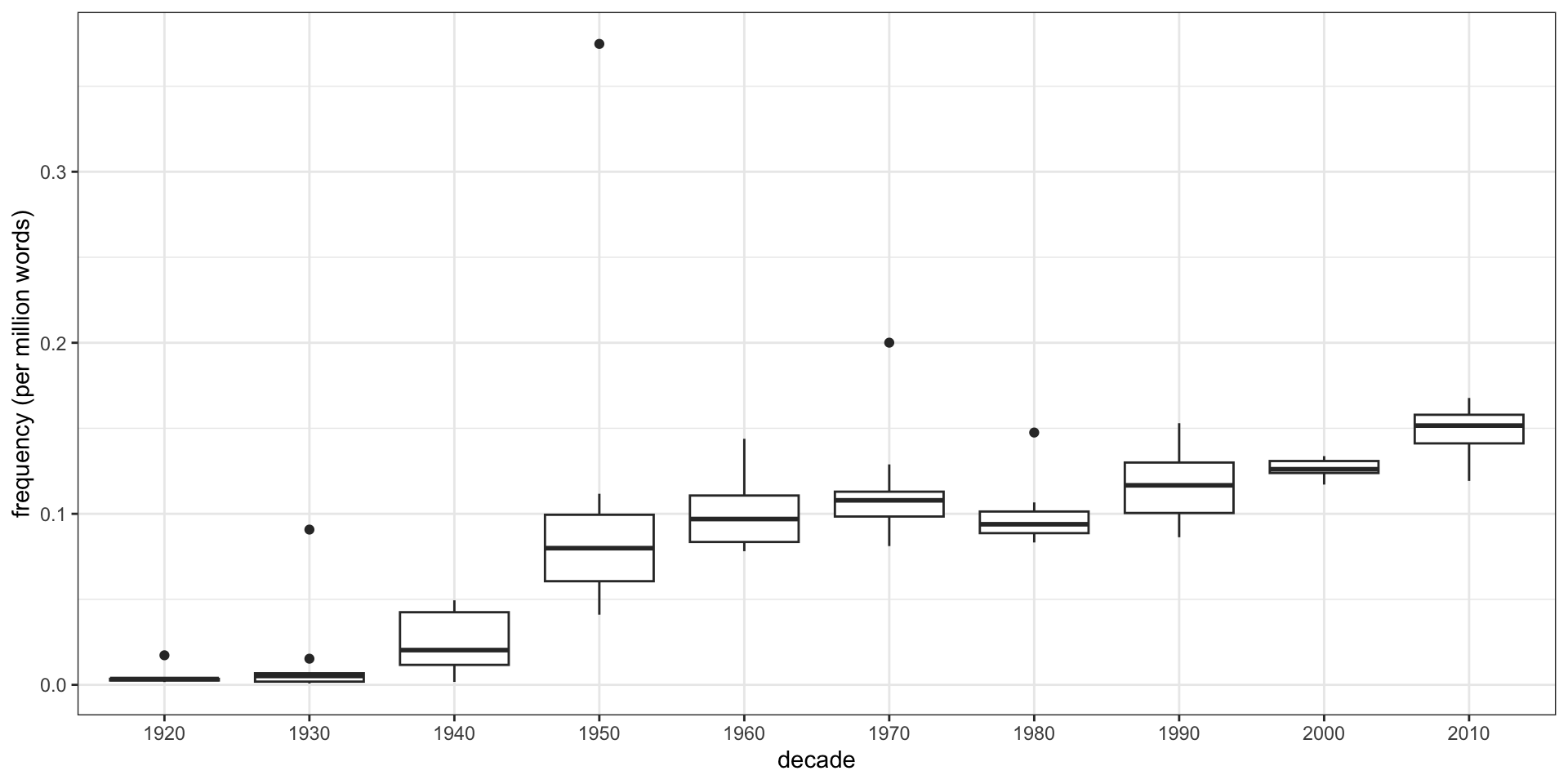
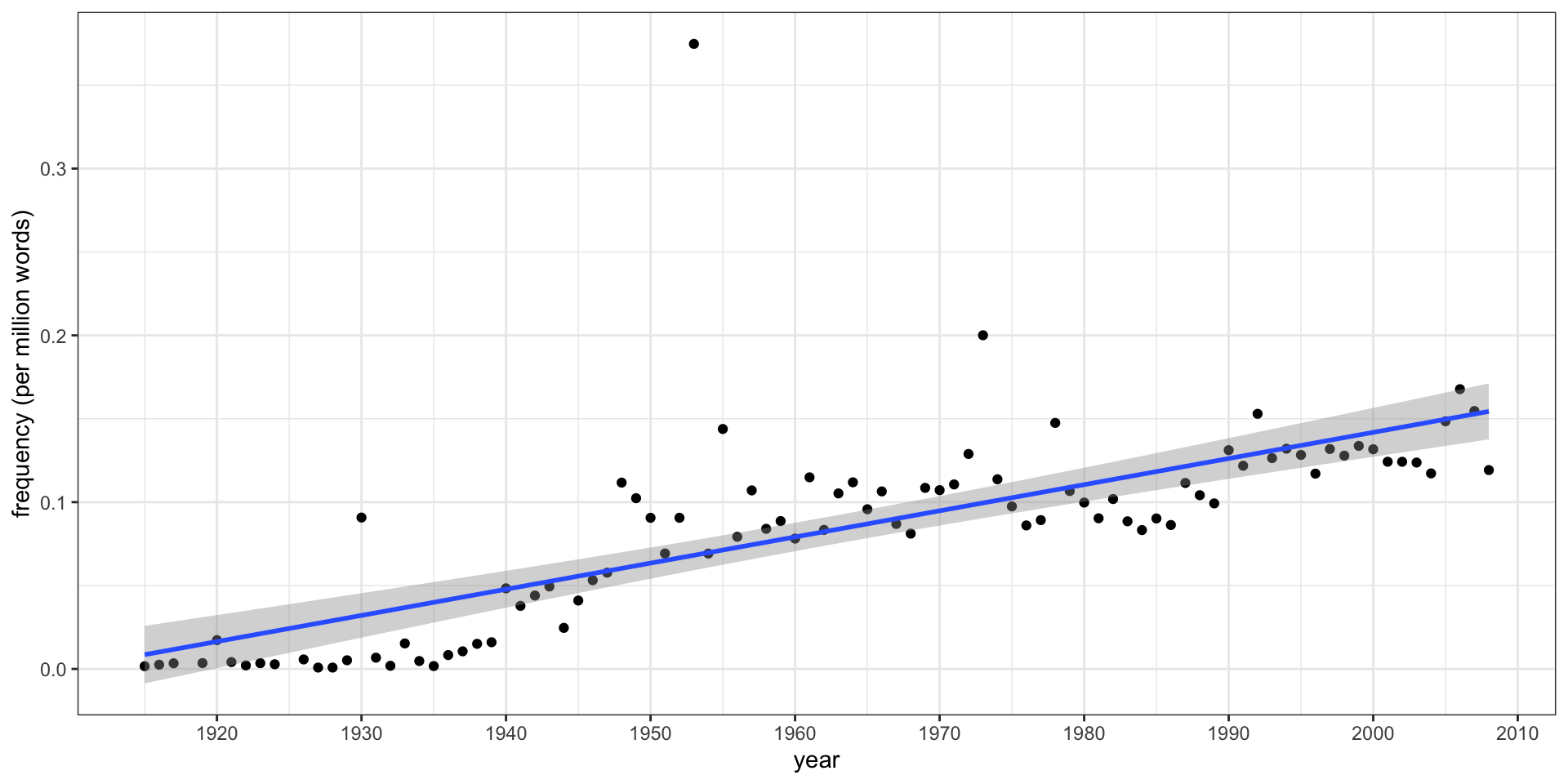
Frequency of witch hunt by year, with trend line
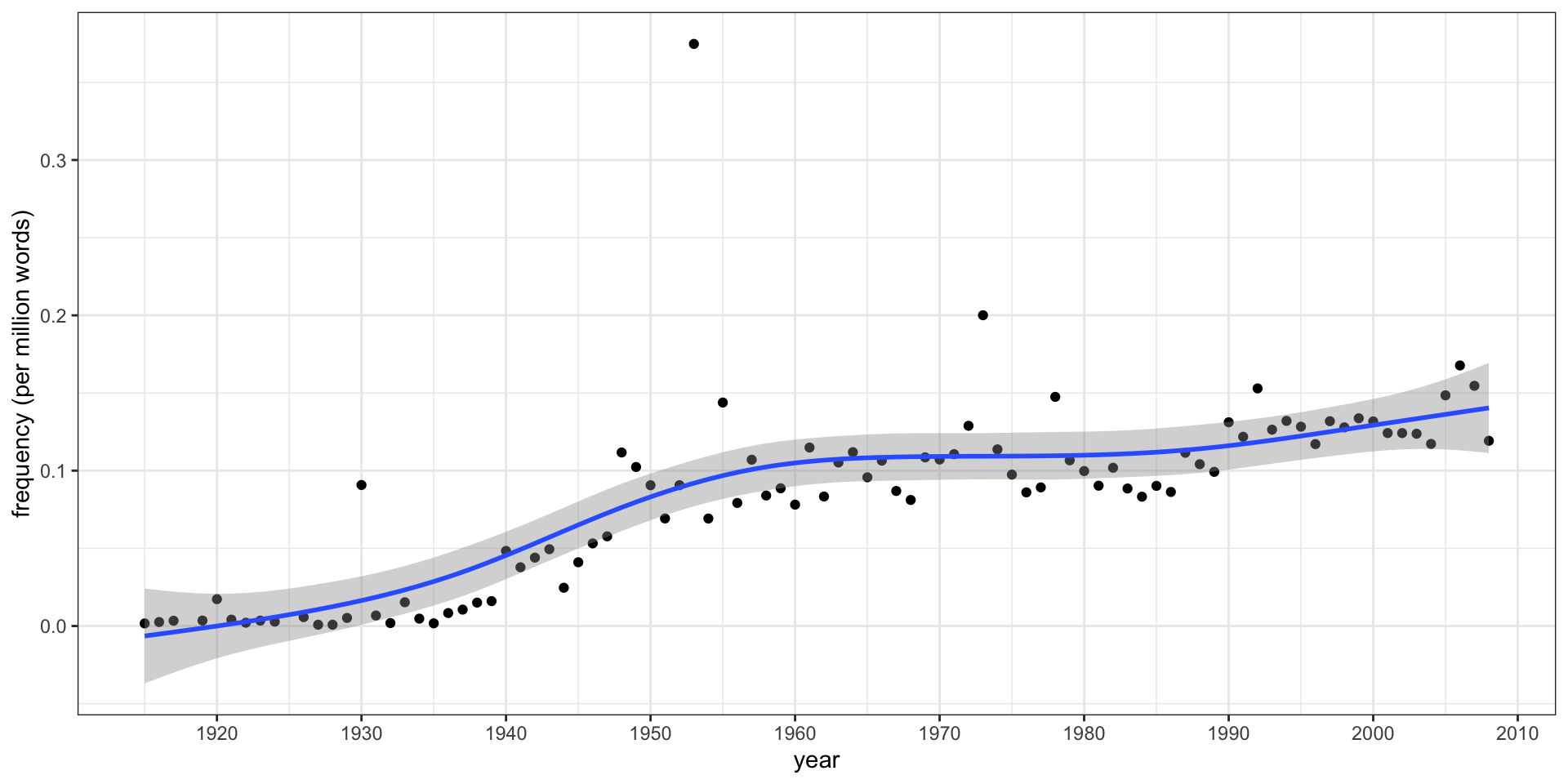
Does this data show a trend?

Summarizing the trend

witch_fit <- lm(Per_10.6 ~ Year, data = wh)
summary(witch_fit)

Call:
lm(formula = Per_10.6 ~ Year, data = wh)

Residuals:
      Min        1Q    Median        3Q       Max 
-0.038200 -0.020285 -0.006718  0.008204  0.306583 

Coefficients:
              Estimate Std. Error t value Pr(>|t|)    
(Intercept) -2.9939744  0.3134828  -9.551 2.46e-15 ***
Year         0.0015679  0.0001597   9.816 6.89e-16 ***
---
Signif. codes:  0 '***' 0.001 '**' 0.01 '*' 0.05 '.' 0.1 ' ' 1

Residual standard error: 0.04101 on 90 degrees of freedom
Multiple R-squared:  0.517, Adjusted R-squared:  0.5117 
F-statistic: 96.35 on 1 and 90 DF,  p-value: 6.895e-16

Danger!

  • This only measures linear trends
  • \(R^2\), as a measure of “variance explained”, is not quite as intuitive as it seems

Peaks and troughs

How do we detect peaks or troughs in usage?

  • A word’s usage may peak at specific times, or it may go through times of low use
    • e.g., a word becomes briefly popular due to a cultural trend
  • How can we distinguish such a shift from random variation?

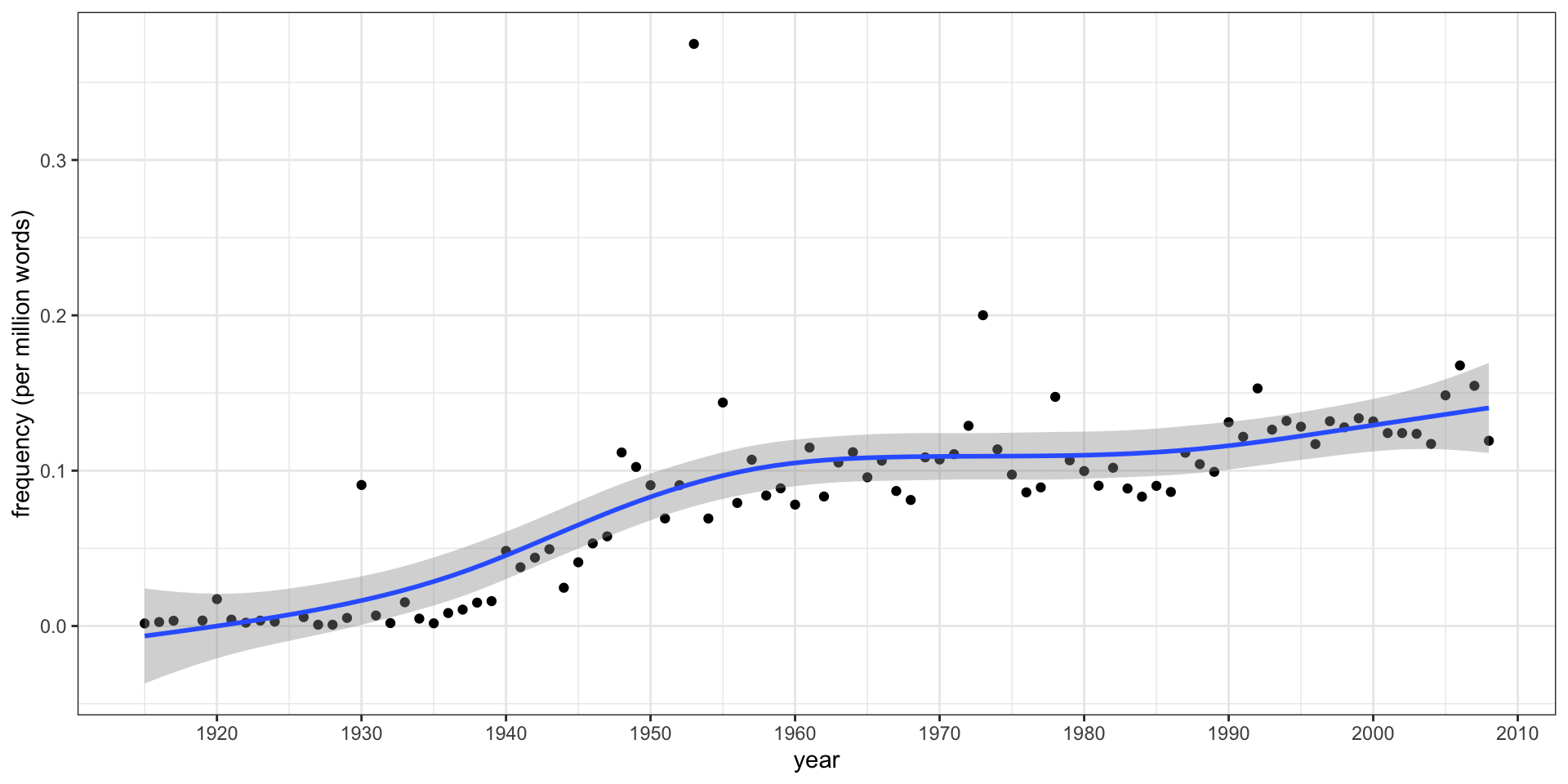
Nonlinear smoothers

  • We can fit a nonlinear smoother to the data, i.e., a regression that allows nonlinear trends
  • Many such smoothers can produce confidence intervals
  • Individual observations outside the CI can indicate peaks or troughs
  • Frequently done with smoothing splines, as fit by mgcv’s gam() function

Peaks and troughs in witch hunt

Time periods

Can we break the data into time periods?

  • To periodize a time series is to split it into distinct time periods
  • If there’s a sudden change in use after 1945, maybe there’s a pre-1945 period and a post-1945 period
  • Statistically, we can think of this several ways:
    • Test if two periods are different: simple hypothesis testing
    • Detect where the mean or slope suddenly changes: changepoint detection
    • Cluster sequences of similar years: clustering

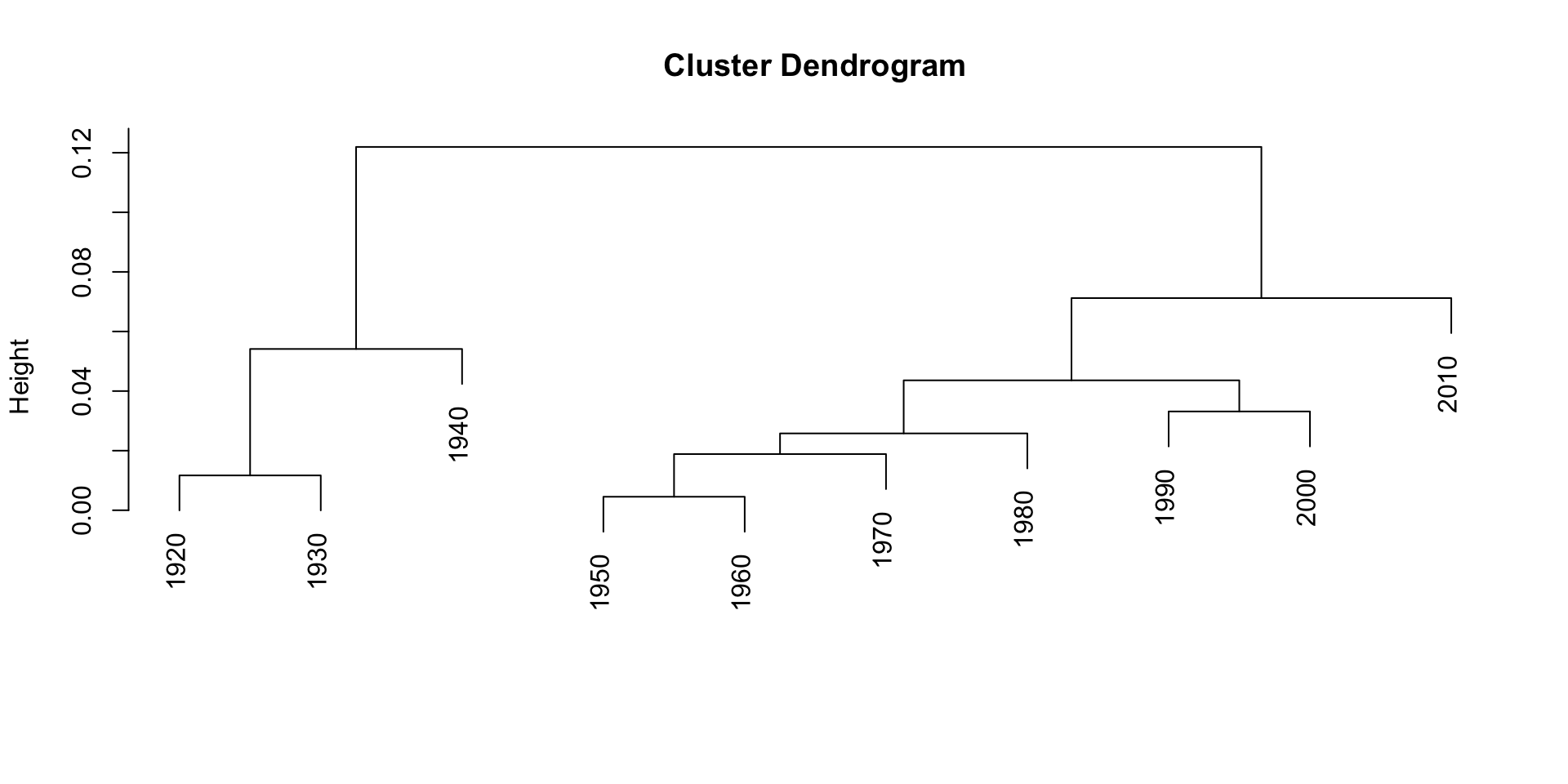
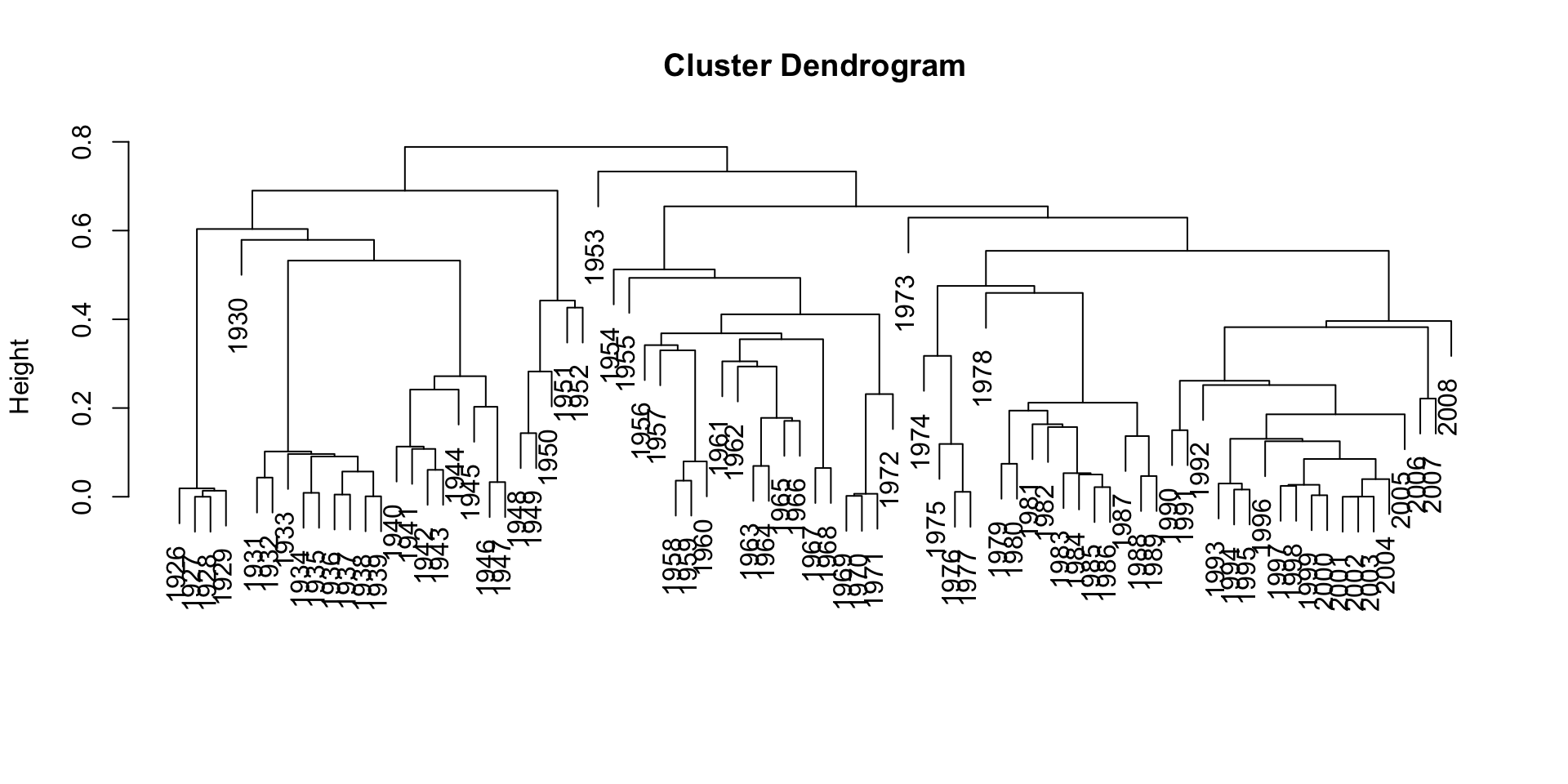
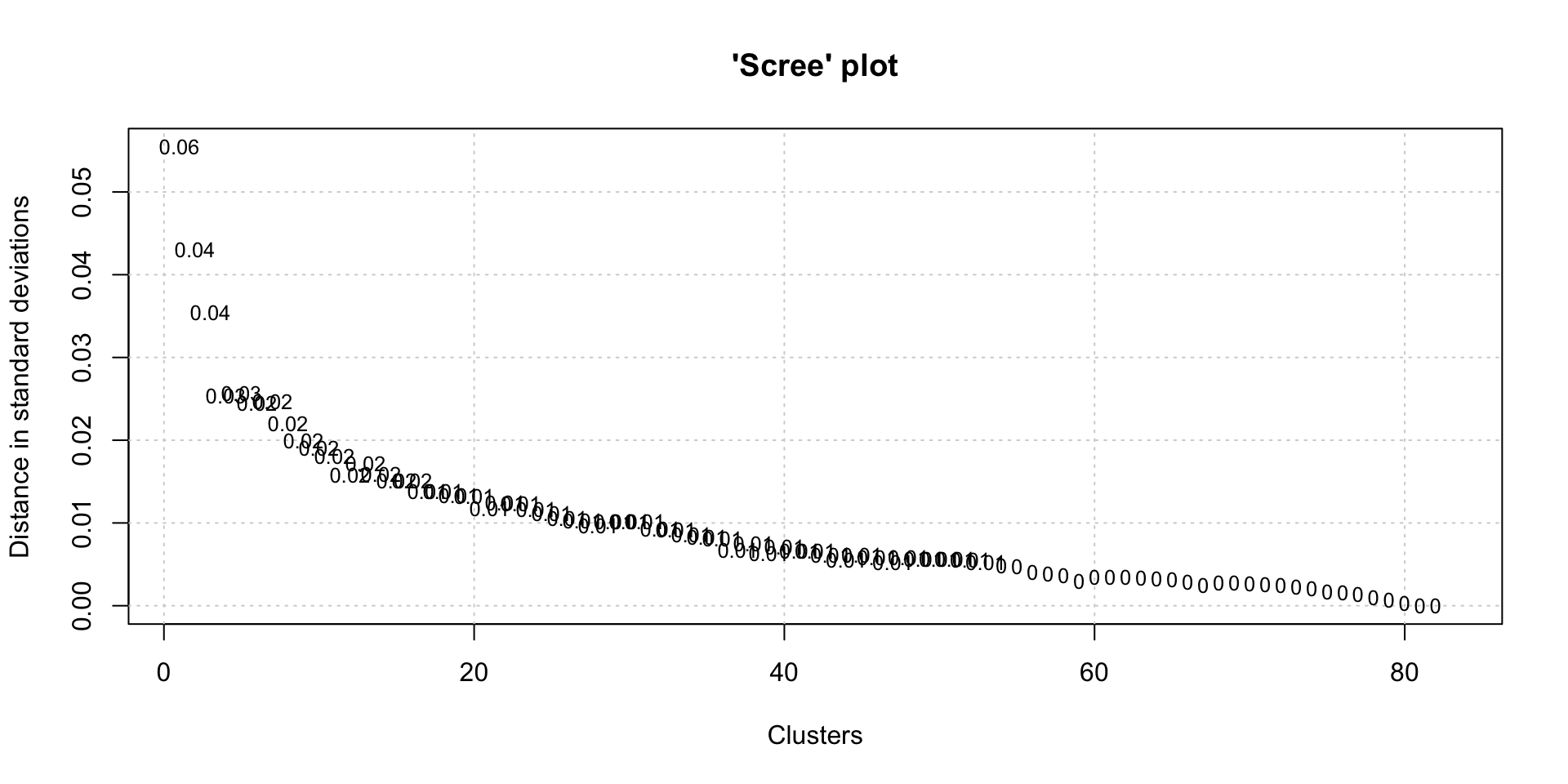
Variability-based neighbor clustering

  • VNC is an adaptation of hierarchical clustering
  • Any time point can be merged with an adjacent time point
  • Linkage is the change in standard deviation (or coefficient of variation) when merged
  • Produces a dendrogram just like hierarchical clustering

Clustering decades

Clustering years

Scree plot
Changes in pronoun use

Do pronouns suggest greater individualism?

Twenge, Campbell, and Gentile (2013) claim that:

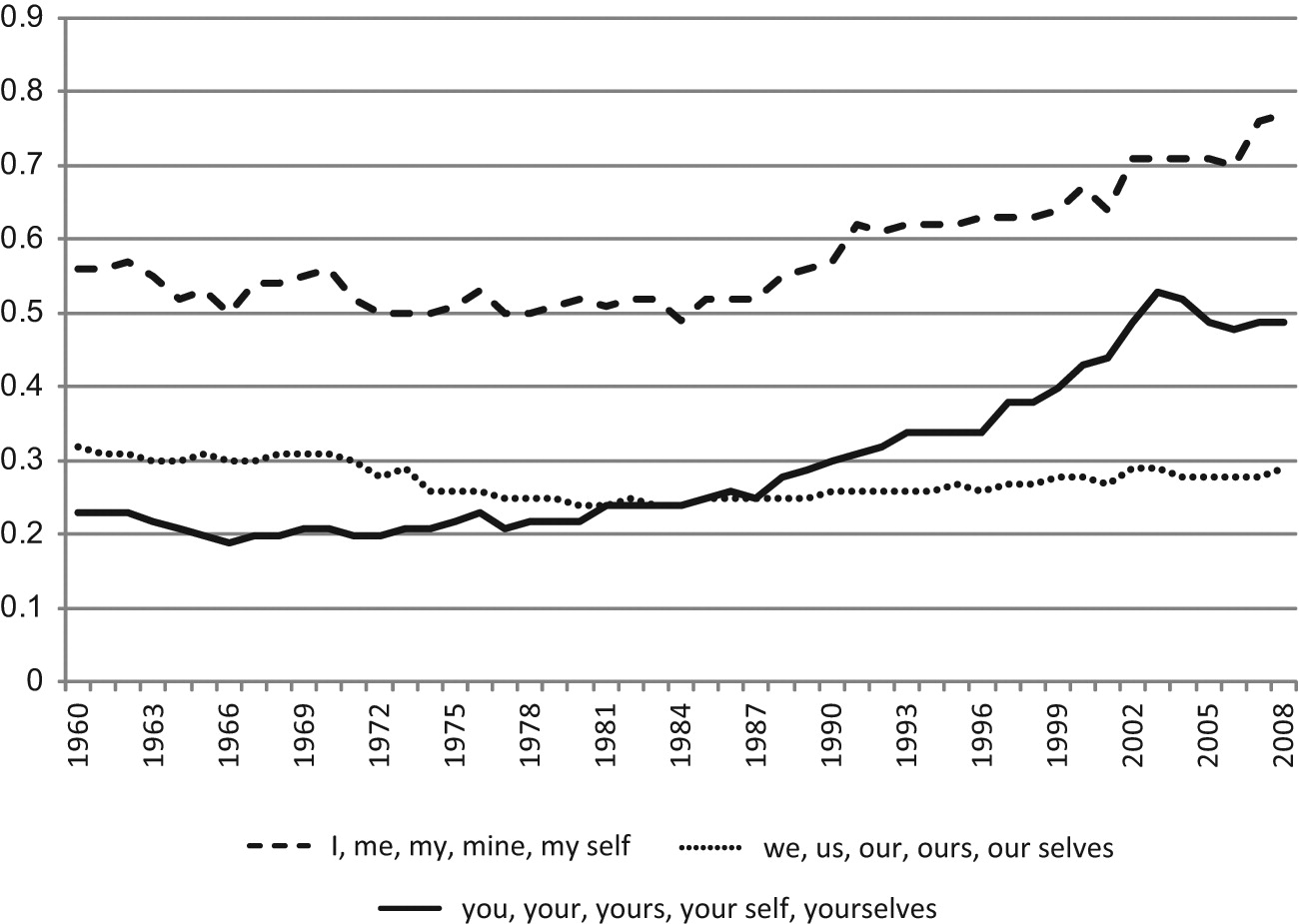
Changes in pronoun use in American books suggest a cultural trend toward greater individualism and a parallel trend toward less collectivism. First person plural pronouns such as “we” decreased in use by 10%, and singular pronouns such as “I” and “me” increased 42%. Previous research linked first person singular pronouns to individualism and first person plural pronouns to collectivism (e.g., Gardner et al., 1999; Kashima & Kashima, 1998; Na & Choi, 2009).

Second person pronouns such as “you” and “your” quadrupled, also consistent with individualism, as they separate the actor and other (Wechsler, 2010). The large increase in second person might partially reflect an increased tendency to directly address the reader and include him or her in the dialogue, another indicator of individualism (e.g., “what you can do,” “your best life”). However, this is speculative.

Their Figure 1

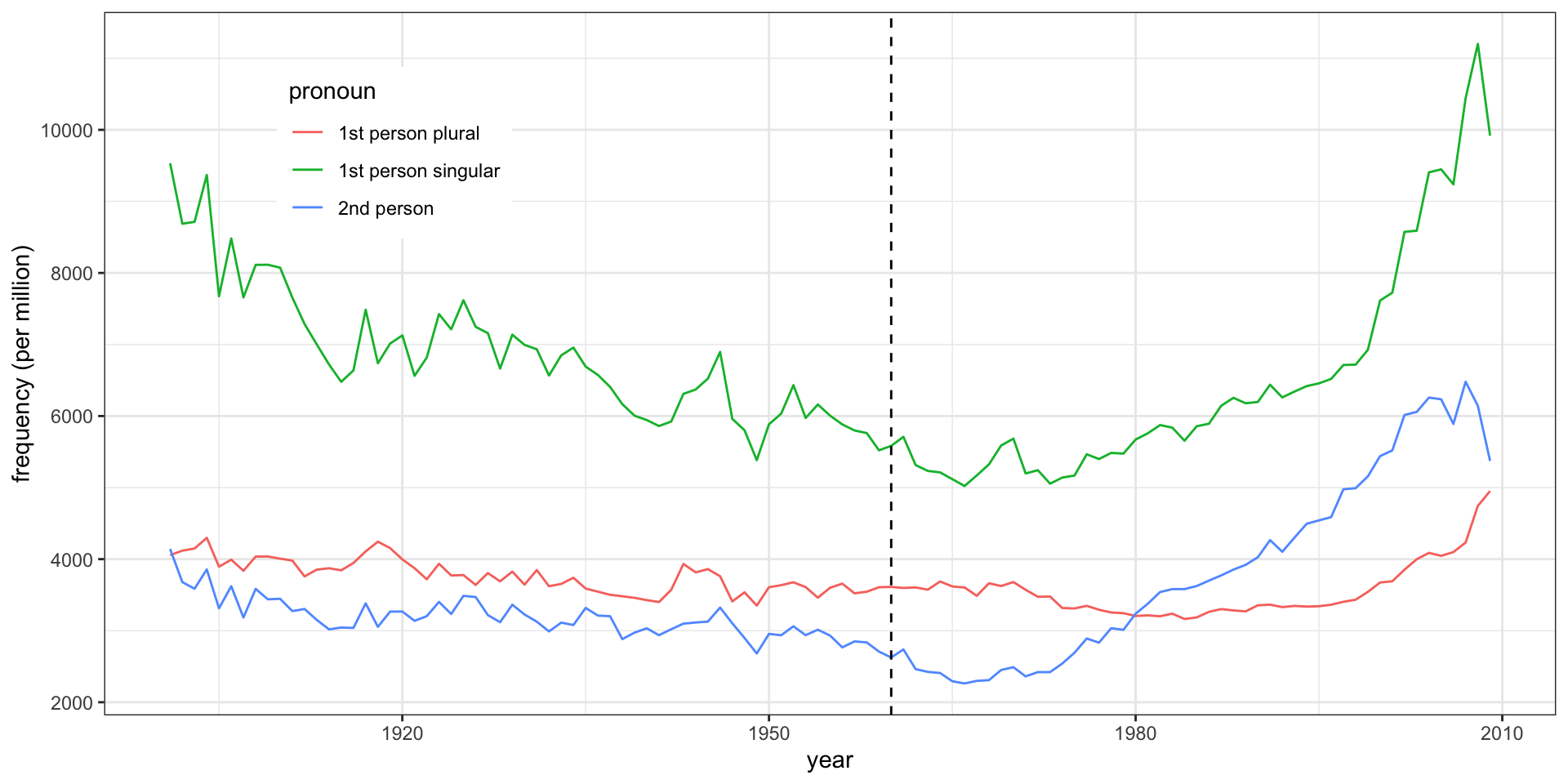
Changes in pronoun use in American books

We can replicate this ourselves:
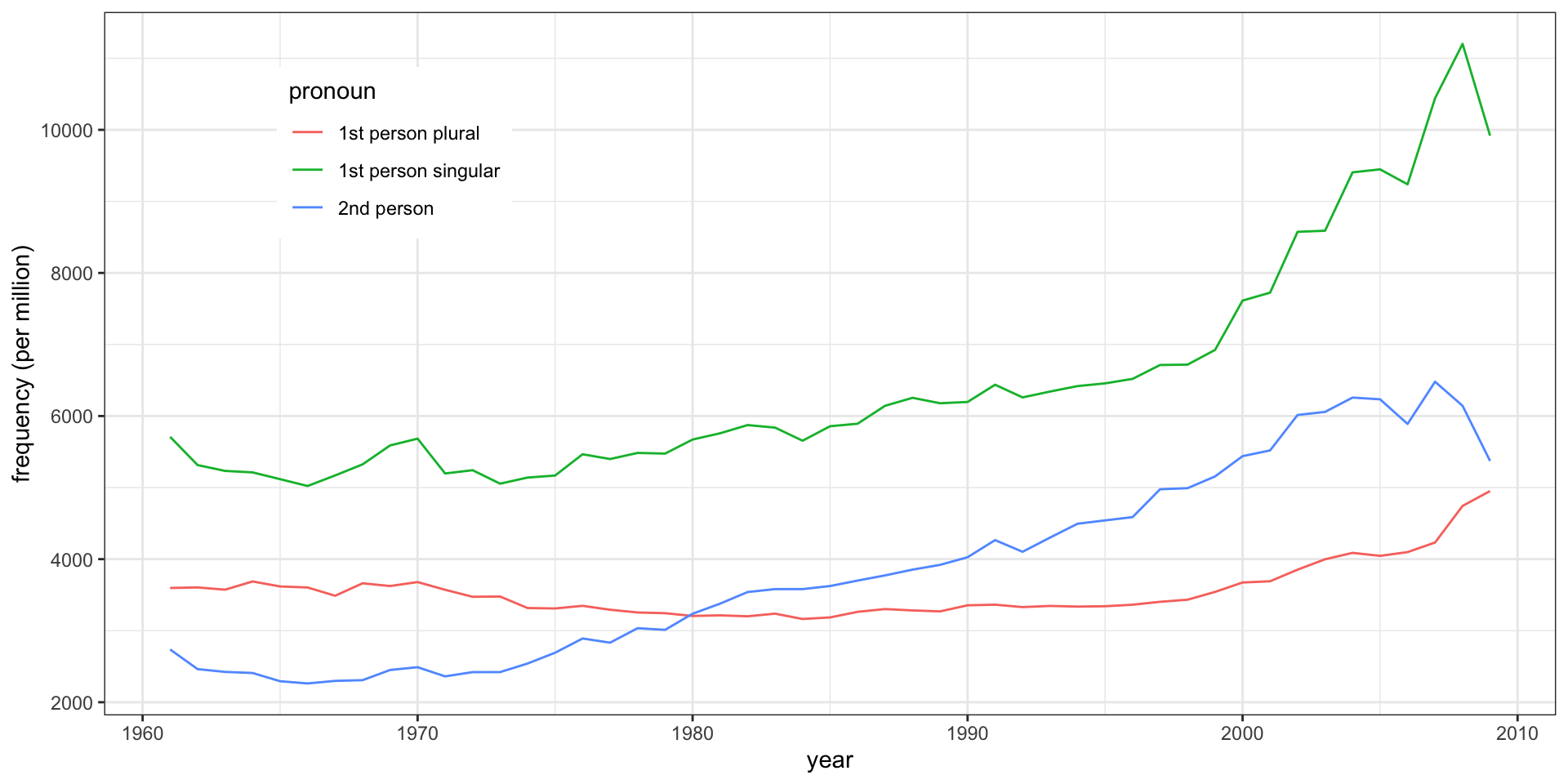
Why 1960 as the starting point?

We chose 1960 as a starting point because many authors have noted that the pace of cultural change in the United States, particularly in individualism, accelerated beginning in the late 1960s through the 1970s…

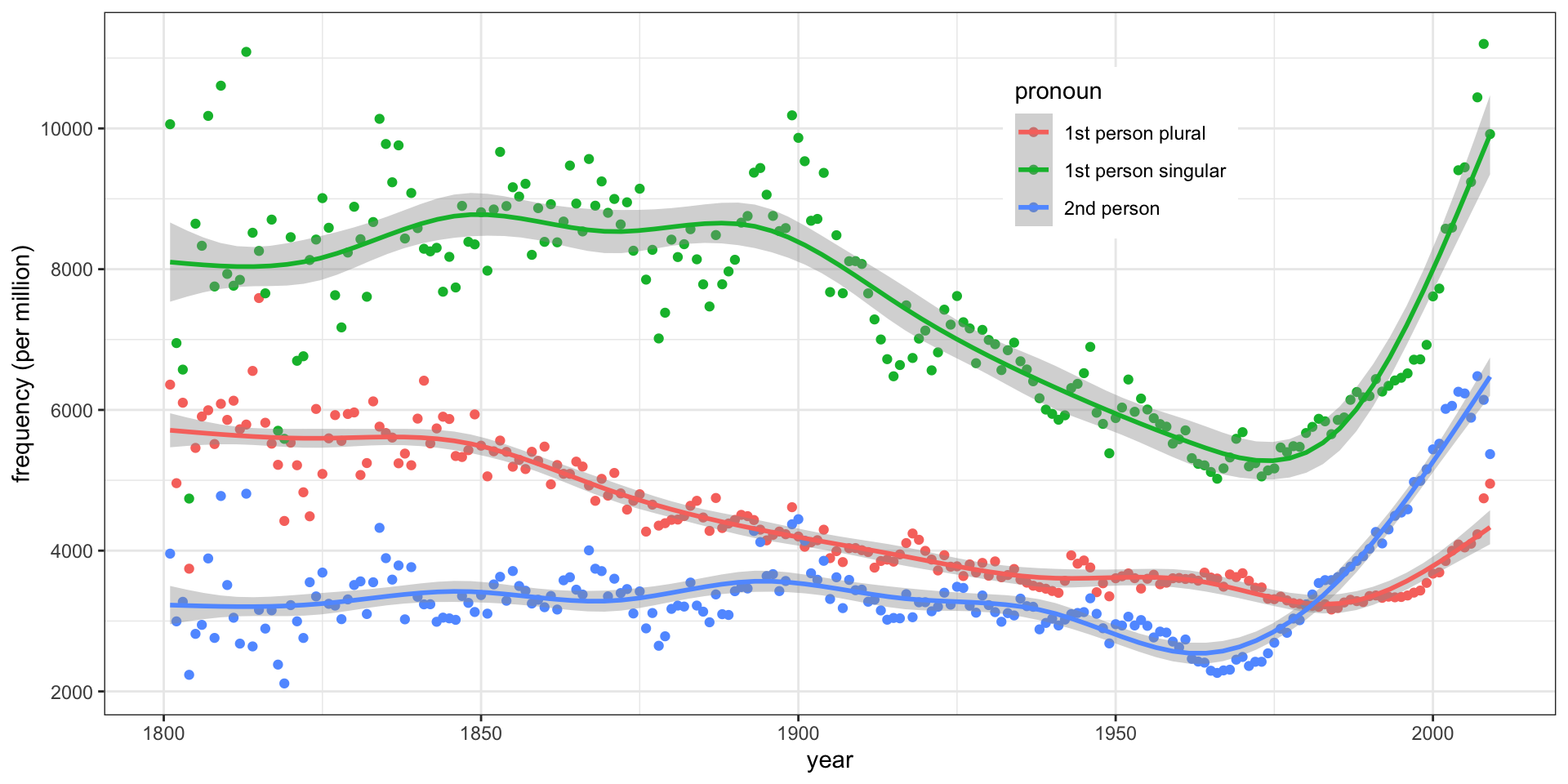
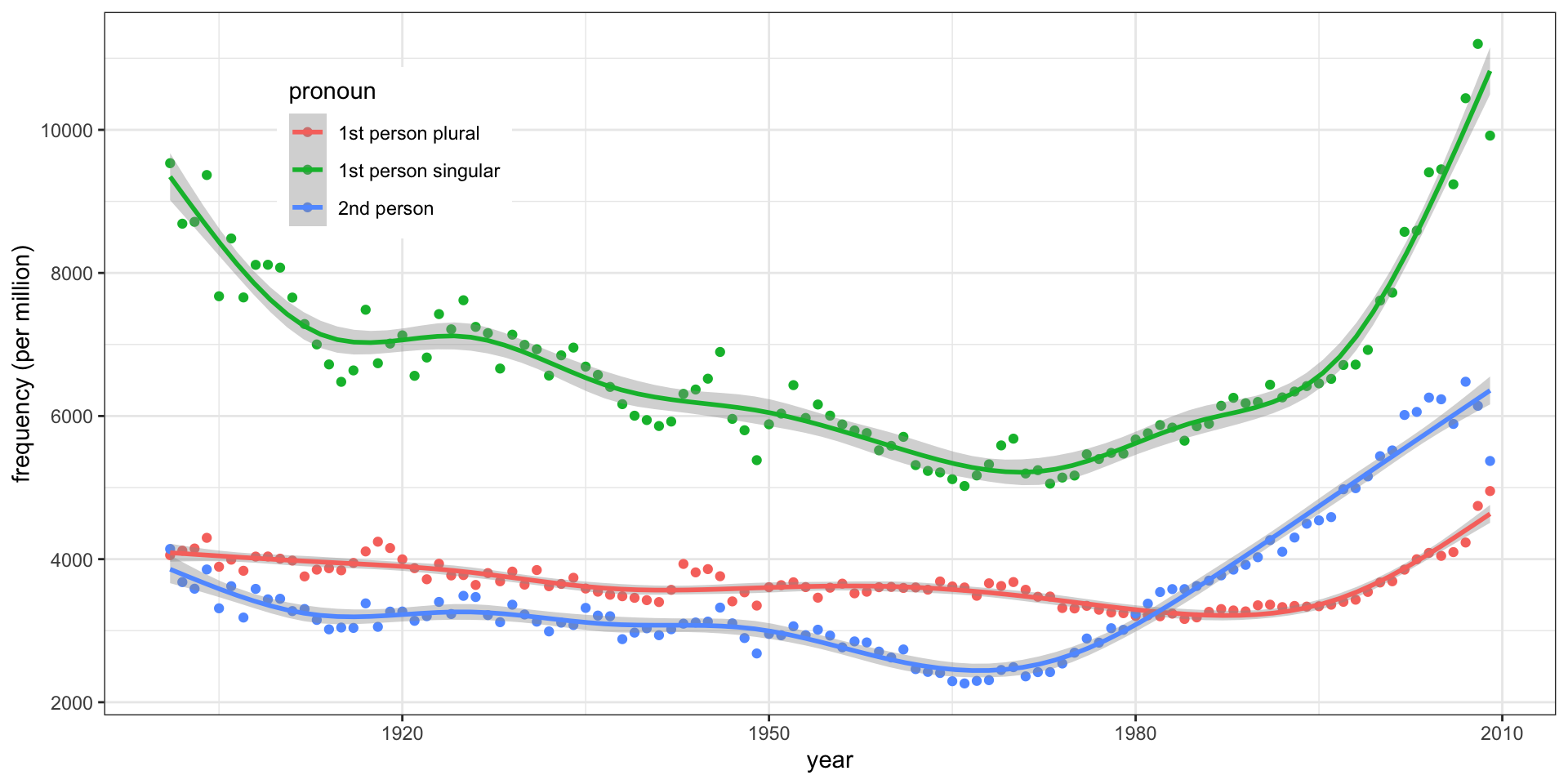
But we can easily include older data to see what happens

Changes in pronoun use since 1900

Changes in pronoun use in American books, smoothed
Works cited

Twenge, Jean M., W. Keith Campbell, and Brittany Gentile. 2013. “Changes in Pronoun Use in American Books and the Rise of Individualism, 1960-2008.” Journal of Cross-Cultural Psychology 44 (3): 406–15. https://doi.org/10.1177/0022022112455100.